Walk into the supplement aisle wanting “magnesium” and you'll leave more confused than you arrived, because the mineral itself is almost never the deciding factor — the form it's bound to is. Glycinate and citrate are two of the most common, and the marketing around both leans hard on one word: absorption. That's not actually where the real difference lives.
The absorption story is smaller than the marketing suggests
Both glycinate and citrate are “organic” magnesium salts (bound to an amino acid and a citric acid molecule respectively), and both are considerably better absorbed than magnesium oxide. Where the marketing overreaches is in claiming a dramatic absorption gap between glycinate and citrate specifically — head-to-head human comparison data doesn't strongly back that up. They're both reasonably well absorbed. The real difference is what happens once they get there, not how much gets in.
Citrate's defining feature is what it does in the gut
Magnesium citrate works, in part, as an osmotic laxative. At moderate-to-higher doses, the portion that isn't absorbed pulls water into the bowel, which softens stool and speeds things along — typically within about six hours. That's a genuinely useful mechanism if constipation or irregularity is the actual problem you're trying to solve.
It's also exactly why citrate isn't the best pick if you just want a general top-up for sleep, muscles, or nerve function without a side trip to the bathroom. EFSA's own risk assessment work identifies osmotic diarrhoea as the limiting factor for how much magnesium you can take from the more readily dissociable salts — citrate among them — well before you'd hit the UK's broader 400mg supplemental guidance for magnesium overall. Different bodies, different reference points, but the pattern holds: citrate tends to announce its upper limit through your gut, glycinate usually doesn't.
Glycinate takes a different route entirely
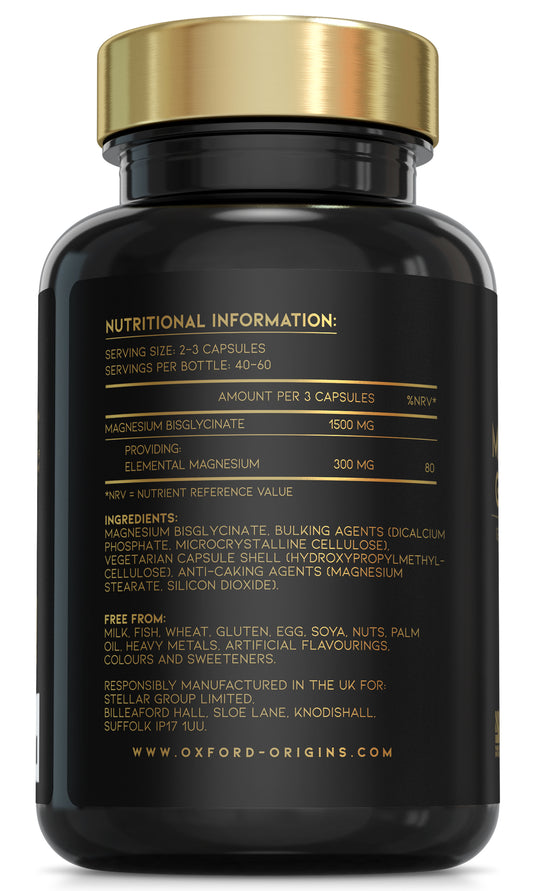
Glycinate is absorbed via a dipeptide transport pathway in the small intestine rather than relying on that osmotic pull, which is the mechanical reason it doesn't produce the same laxative effect even at meaningfully higher doses. That makes it the more comfortable option for anyone taking magnesium daily and long-term purely for its authorised roles in normal muscle function, normal nervous system function, and reducing tiredness and fatigue — the goal being steady topping-up, not a bowel reset.
So which one do you actually need?
If constipation or irregularity is the problem you're solving, citrate is the more appropriate tool — that's what its mechanism is built for. If you want magnesium for sleep, muscle tension, or general nervous system support without the gut disruption, glycinate is the better-suited form, and it's the one with more specific research behind it for sleep in particular (we've gone deeper on that in our piece on magnesium glycinate and sleep).

If you'd rather not choose at all, that's the actual logic behind a complex like ours that combines glycinate and citrate with malate and taurate in smaller individual amounts — spreading the load across forms rather than leaning on one mechanism alone, at a dose gentle enough for sensitive stomachs.
The standard, not the shortcut
Becoming the standard, to us, means telling you that the “best” magnesium depends entirely on what you're trying to fix — not picking a side and dressing it up as universal advice. Citrate and glycinate aren't competing for the same job. They're just doing different ones.
Frequently asked questions
Can you take magnesium glycinate and citrate together?
Yes — there's no known issue combining the two forms, and that's essentially what a multi-form complex does, just in smaller individual amounts of each rather than a full dose of one.
Does magnesium citrate cause diarrhoea?
At moderate-to-higher doses, yes — that's its defining mechanism, not a side effect in the usual sense. It works by drawing water into the bowel. Magnesium glycinate doesn't share this mechanism and is generally much gentler on digestion.
Which magnesium is best for constipation?
Citrate, specifically because of its osmotic laxative effect — it's one of the more established uses for this particular form.
Which magnesium is best for sleep?
Glycinate is the more commonly studied and recommended form for sleep specifically, partly because it doesn't come with the gut disruption that limits how much citrate people can comfortably take.
At Oxford Origins, your wellbeing is our priority, and although we pride ourselves on our expertise in nutrition and supplementation, it's important to acknowledge the individuality of each person. Articles published by Oxford Origins are not intended to treat, diagnose, cure or prevent any disease, or replace the advice of your GP. We always recommend consulting with a healthcare provider if you encounter any health concerns, and we'll always be here to support you so you're never alone on your journey.