Ask the NHS about glucosamine and chondroitin and you'll get a short, unglamorous answer: GPs stopped prescribing them years ago because the evidence isn't strong enough.[1] Ask a supplement aisle, and you'll get the opposite — six-in-one formulas, "joint care" branding, five-star reviews. Somewhere between those two answers is what actually happened in the trials, and it's more interesting than either extreme.
We're not going to pretend this is simple. It isn't. But it's worth working through properly, because the honest version of this story is still a reason some people take these three ingredients — just not the reason the marketing usually gives you.
What's actually in a joint supplement like this
Glucosamine and chondroitin are both naturally occurring compounds found in cartilage — the connective tissue that cushions your joints. The theory behind supplementing them is straightforward: give the body more of the raw material, and it might use it to maintain that cushioning. MSM (methylsulfonylmethane) is a sulphur compound usually added alongside them, on the basis that sulphur is a building block of connective tissue too.
It's a tidy theory. Human joints, unfortunately, don't always cooperate with tidy theories.
What the big trials actually found
The largest test of this was the Glucosamine/chondroitin Arthritis Intervention Trial (GAIT) — a five-year, NIH-funded study of 1,583 people with knee osteoarthritis, published in the New England Journal of Medicine. Across the whole group, glucosamine and chondroitin — alone or combined — didn't outperform placebo.[3]
That's the headline. It's also not the whole story.
Buried in the same trial was a subgroup — people with moderate-to-severe knee pain specifically — where the combination did noticeably better than placebo. It's an exploratory finding, not the trial's main result, so it shouldn't be read as proof. But it's a real, published number from a real, independent trial, and it's the closest thing this category has to solid ground: if these ingredients do anything, it looks like they do it for people whose pain is already fairly significant, not as a general-purpose joint tonic for everyone.
NICE reached its own conclusion from the wider evidence base and landed somewhere firmer: its current osteoarthritis guideline says not to offer glucosamine or chondroitin for managing the condition at all.[2] That's a clinical guideline written for treating a diagnosed condition on the NHS, not a verdict on whether an individual might notice something from taking it — but it's honest, and it's the context worth having before you spend money on a bottle.
Why the form of glucosamine seems to matter
One thing that keeps surfacing in the research is that not all glucosamine behaves the same. A widely cited 2007 analysis in Arthritis & Rheumatism looked at why trial results were so inconsistent and found that glucosamine hydrochloride trials consistently underperformed, while glucosamine sulphate trials — particularly those using one specific manufacturer's formulation — reported better results.[5] The same analysis flagged that industry-funded trials tended to report rosier outcomes than independent ones, which is exactly the kind of detail worth knowing rather than glossing over.
"If these ingredients do anything, it looks like they do it for people whose pain is already fairly significant — not as a general-purpose joint tonic for everyone."
It's also worth flagging that GAIT used 1,500mg of glucosamine and 1,200mg of chondroitin sulphate daily — a specific dose combination that doesn't always match what's on a retail label. Different formula, different amounts, and you're no longer looking at the same evidence. That's not a reason to dismiss a product outright, but it is a reason to read the label rather than the marketing.
What to check on a joint supplement label before buying
- Glucosamine sulphate, not just "glucosamine" — the sulphate form has the stronger track record; hydrochloride is cheaper to make but weaker in trials.
- A real chondroitin sulphate dose — some budget formulas list it deep in a proprietary blend with no milligram figure at all.
- Realistic expectations on timeline — NHS guidance on glucosamine notes any change in pain typically takes several weeks to show up, not days.[1]
Where MSM fits in
MSM is the newest addition to this trio and has the thinnest evidence of the three. A small pilot trial published in Osteoarthritis and Cartilage gave 50 people with knee osteoarthritis either 3g of MSM twice daily or placebo for 12 weeks, and found meaningful improvements in pain and physical function in the MSM group.[6] Promising, but it's one small, short study — not the kind of evidence base that supports a bold claim, and we won't pretend otherwise.
Where a formula like this can make an honest claim is on the vitamin C it typically carries alongside the other ingredients (often from citrus bioflavonoid extract). Vitamin C has an EFSA-authorised claim for contributing to normal collagen formation for the normal function of cartilage[7] — a genuinely different, much better-substantiated claim than anything made for glucosamine or chondroitin themselves, and one that's easy to miss on a crowded label.
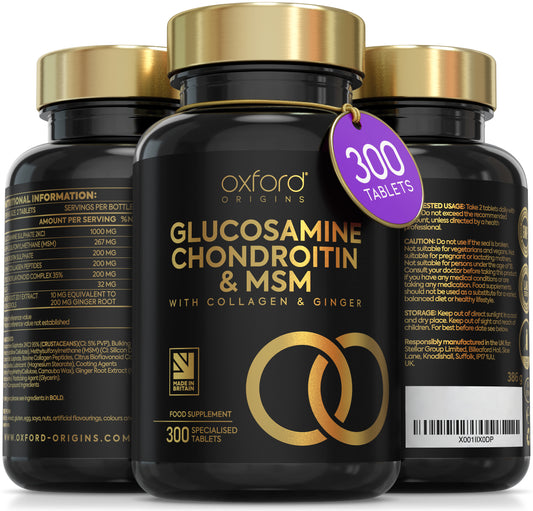
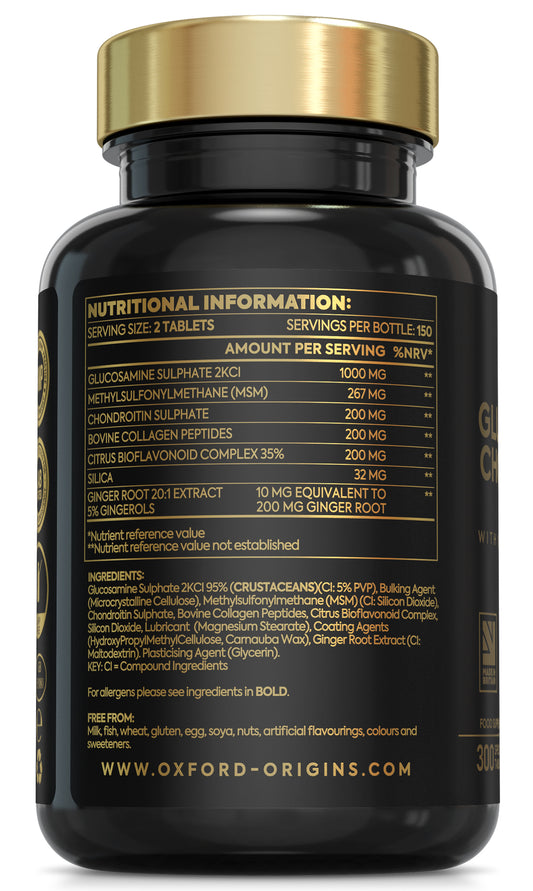
If you've read this far and are weighing up whether a six-in-one joint formula is worth it, Oxford Origins' Glucosamine, Chondroitin & MSM takes the straightforward route: 1000mg glucosamine sulphate and 200mg chondroitin sulphate per two-tablet serving, alongside MSM, collagen and the citrus bioflavonoid vitamin C mentioned above — the sulphate form, dosed and labelled plainly, rather than buried in a blend.

So should you bother?
Honestly — it depends what you're hoping for. If you're picturing a fix, the evidence doesn't back that up, and NICE is quite clear it shouldn't replace exercise, weight management or medical advice for a diagnosed joint condition.[2] If you're someone with moderate joint discomfort who wants to try something low-risk alongside those fundamentals, and you go in with the GAIT subgroup finding rather than the marketing copy as your benchmark, that's a more reasonable place to start.
Either way, movement, a healthy weight and consistent strength work still do more for most joints than any capsule will. That's not the exciting answer. It's just the accurate one — and at Oxford Origins, we'd rather give you that than a shinier version that doesn't hold up.
Frequently asked questions
How long does it take for glucosamine and chondroitin to work?
If you notice anything at all, NHS guidance suggests it typically takes several weeks of consistent use before any change in pain becomes apparent — this isn't a fast-acting painkiller, and trials generally ran for 12 to 24 weeks before assessing results.[1]
Is it safe to take glucosamine and chondroitin every day, long term?
The safety profile across trials, including the two-year GAIT follow-up, has generally been reassuring, with side effects similar to placebo.[3] Glucosamine is typically made from shellfish, so it's not suitable if you have a shellfish allergy, and anyone on blood-thinning medication should check with a pharmacist or GP first, as there have been isolated reports of interactions.
What's the difference between glucosamine sulphate and glucosamine hydrochloride?
They're different salt forms of the same underlying molecule. Sulphate has the more favourable trial record, while hydrochloride versions have generally underperformed in independent research, though some of that gap may also reflect which trials were industry-funded.[5] Checking which form is on the label is a reasonable first step if you're choosing between products.
Should I take glucosamine and chondroitin instead of turmeric for joint pain?
They work through different mechanisms — turmeric's curcumin is studied mainly for its anti-inflammatory action, while glucosamine and chondroitin are structural building blocks of cartilage — so it isn't really an either/or choice. We've gone into the turmeric evidence in more depth in Turmeric and Joint Health: Separating the Hype from the Evidence, if you want to compare the two.
Sources
- NHS — Osteoarthritis: Treatment and support, cited for GPs no longer prescribing glucosamine/chondroitin and typical timeline for any effect. https://www.nhs.uk/conditions/osteoarthritis/treatment/
- NICE — Osteoarthritis in over 16s: diagnosis and management (NG226), cited for the recommendation not to offer glucosamine or chondroitin for managing osteoarthritis. https://www.nice.org.uk/guidance/ng226/chapter/Recommendations
- Clegg DO, et al. "Glucosamine, Chondroitin Sulfate, and the Two in Combination for Painful Knee Osteoarthritis." New England Journal of Medicine, 2006 (the GAIT trial), cited for overall and subgroup results and long-term safety data. https://www.nejm.org/doi/full/10.1056/NEJMoa052771
- Vlad SC, et al. "Glucosamine for pain in osteoarthritis: why do trial results differ?" Arthritis & Rheumatism, 2007, cited for the difference between glucosamine sulphate and hydrochloride trial outcomes and industry-funding bias. https://onlinelibrary.wiley.com/doi/10.1002/art.22728
- Kim LS, et al. "Efficacy of methylsulfonylmethane (MSM) in osteoarthritis pain of the knee: a pilot clinical trial." Osteoarthritis and Cartilage, 2006, cited for MSM pilot trial results. https://www.oarsijournal.com/article/S1063-4584(05)00285-2/fulltext
- EFSA NDA Panel — Scientific Opinion on vitamin C and collagen formation, EFSA Journal 2009;7(9):1226, cited for the authorised claim on vitamin C and normal collagen formation for the normal function of cartilage. https://efsa.onlinelibrary.wiley.com/doi/pdf/10.2903/j.efsa.2009.1226
At Oxford Origins, your wellbeing is our priority, and although we pride ourselves on our expertise in nutrition and supplementation, it's important to acknowledge the individuality of each person. Articles published by Oxford Origins are not intended to treat, diagnose, cure or prevent any disease, or replace the advice of your GP. We always recommend consulting with a healthcare provider if you encounter any health concerns, and we'll always be here to support you so you're never alone on your journey.