Collagen is the most-hyped supplement on the shelf right now, and also one of the hardest to get an honest answer about. Search for evidence and you'll find studies proving it works and studies finding nothing at all — often on the exact same outcome. That's not a reason to dismiss it. It's a reason to look at which studies you're actually reading.
What's actually happening when you swallow it
Whole collagen protein is too large and structurally rigid for your gut to absorb intact, which is why supplements use hydrolysed collagen — collagen broken down into smaller peptides. Recent research using blood sampling has confirmed that specific peptides, particularly one called Pro-Hyp (prolyl-hydroxyproline) and its longer cousin Gly-Pro-Hyp, survive digestion and show up measurably in blood plasma within one to two hours of taking a dose.[1] That part isn't in dispute — the peptides genuinely get in.
What happens after that, in terms of your skin actually producing more of its own collagen, is where the evidence gets more complicated.
The skin evidence is real, with an uncomfortable catch
A 2025 systematic review and meta-analysis in The American Journal of Medicine pooled 23 randomised controlled trials covering 1,474 participants and found that, overall, collagen supplements improved skin hydration, elasticity, and wrinkle appearance.[2] That sounds like a clear result — until you look at how the effect broke down. Studies funded by supplement or collagen manufacturers showed a significant benefit. Independently funded studies, without that financial backing, showed no significant effect on any of those measures. A separate quality analysis found the same pattern: higher-quality trials tended to show no significant benefit, while lower-quality ones were more likely to report one.
"The strongest, most convincing results in this space are disproportionately coming from research with a financial interest in the outcome."
That doesn't mean collagen definitely does nothing for skin. It's exactly the kind of thing worth knowing before you spend money based on a headline stat.
Why there's no official claim to point to
Unlike magnesium or vitamin D, collagen doesn't have an EFSA-authorised health claim it can legally lean on, because it isn't classified and assessed the way vitamins and minerals are. That's not a red flag exactly — plenty of genuinely useful ingredients sit outside that particular regulatory framework — but it does mean there's no official, checked stamp of approval to point to here the way there is for something like magnesium and tiredness. Any claim you see about collagen and skin is resting on the individual studies behind it, not a pre-approved claim, which is exactly why the funding pattern above matters so much.
So is it worth taking?
Our honest read: the peptide absorption is real and measurable, the skin benefit signal exists but is inconsistent and skews toward industry-funded research, and most trials run 8 to 12 weeks before showing any change worth mentioning — so this isn't a supplement to judge after a week.
If you decide to try it, go in expecting a modest, unproven-but-plausible effect rather than a guaranteed transformation, and give it the full trial window before deciding either way.
Collagen production also naturally declines with age, and drops more sharply around menopause specifically — we've covered some of those broader hormonal changes in What Happens During Menopause, if that stage of life is part of why you're looking into this.
If you're going to try it despite the mixed evidence, look for hydrolysed Type 1 collagen paired with complementary actives like hyaluronic acid and vitamin C — the same peptide type the plasma-absorption research above actually measured, rather than a vague "collagen" claim with no format specified.

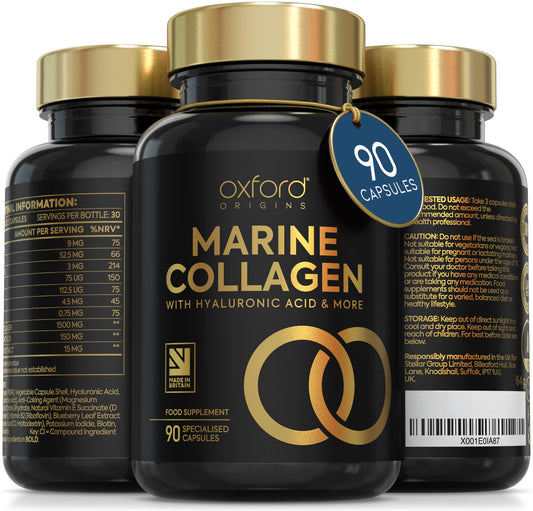
Ours pairs hydrolysed Type 1 marine collagen with hyaluronic acid, vitamin C, E, B2 and zinc. It's out of stock as we write this — given the funding-bias caveat two sections up, we'd rather you wait for a genuine restock notification than be pushed toward buying on a headline stat.
The standard, told straight
Becoming the standard sometimes means telling you the honest, slightly less exciting version of a popular story. Collagen isn't a scam, but it isn't settled science either — and anyone telling you otherwise is probably the one funding the study.
Frequently asked questions
How long does it take to see results from collagen supplements?
Most trials run 8 to 12 weeks before measuring skin hydration or elasticity changes, so that's the realistic window to judge by — not days or a couple of weeks.
Does marine collagen work better than bovine collagen?
There's no strong evidence that one source is more effective than the other. Both typically provide Type I collagen peptides; the choice tends to come down to dietary preference or allergen avoidance rather than a proven efficacy difference.
Can you get enough collagen from food instead of supplements?
Bone broth and connective-tissue-rich cuts of meat contain some collagen and gelatin, though in less concentrated, less standardised amounts than a supplement. Vitamin C-rich foods also support your body's own natural collagen production, which is a separate but complementary angle.
Is there an EFSA-approved health claim for collagen?
No. Collagen isn't assessed and authorised the way vitamins and minerals are, so any claims about it rest on individual studies rather than an official pre-approved claim — worth knowing when comparing it to nutrients like magnesium or vitamin D that do carry authorised claims.
Sources
- Frontiers in Nutrition — randomised, double-blind crossover study on plasma absorption of Pro-Hyp/Gly-Pro-Hyp collagen peptides: frontiersin.org/journals/nutrition/articles/10.3389/fnut.2024.1416643/full
- The American Journal of Medicine — 2025 systematic review and meta-analysis of 23 RCTs on collagen supplements and skin aging, effects split by funding source: amjmed.com/article/S0002-9343(25)00283-9/abstract
At Oxford Origins, your wellbeing is our priority, and although we pride ourselves on our expertise in nutrition and supplementation, it's important to acknowledge the individuality of each person. Articles published by Oxford Origins are not intended to treat, diagnose, cure or prevent any disease, or replace the advice of your GP. We always recommend consulting with a healthcare provider if you encounter any health concerns, and we'll always be here to support you so you're never alone on your journey.